Motor skills are the foundation of everything your child does — from picking up a pencil to kicking a ball. Understanding the difference between fine and gross motor skills is the first step to supporting your child's development.
By Sonali | 8 min read | Informed by recent research (2024–2025)
Every time your child buttons a shirt, hops across the garden, or draws a picture, they are using motor skills. These abilities are not just physical milestones — they are deeply connected to a child's academic achievement, social confidence, emotional well-being, and independence in daily life. Yet many parents are unaware of the crucial difference between the two types of motor skills, or that difficulties in either area can be identified early and addressed effectively through occupational therapy.
Motor skills are broadly divided into two categories, each involving different muscle groups and supporting different aspects of daily life.
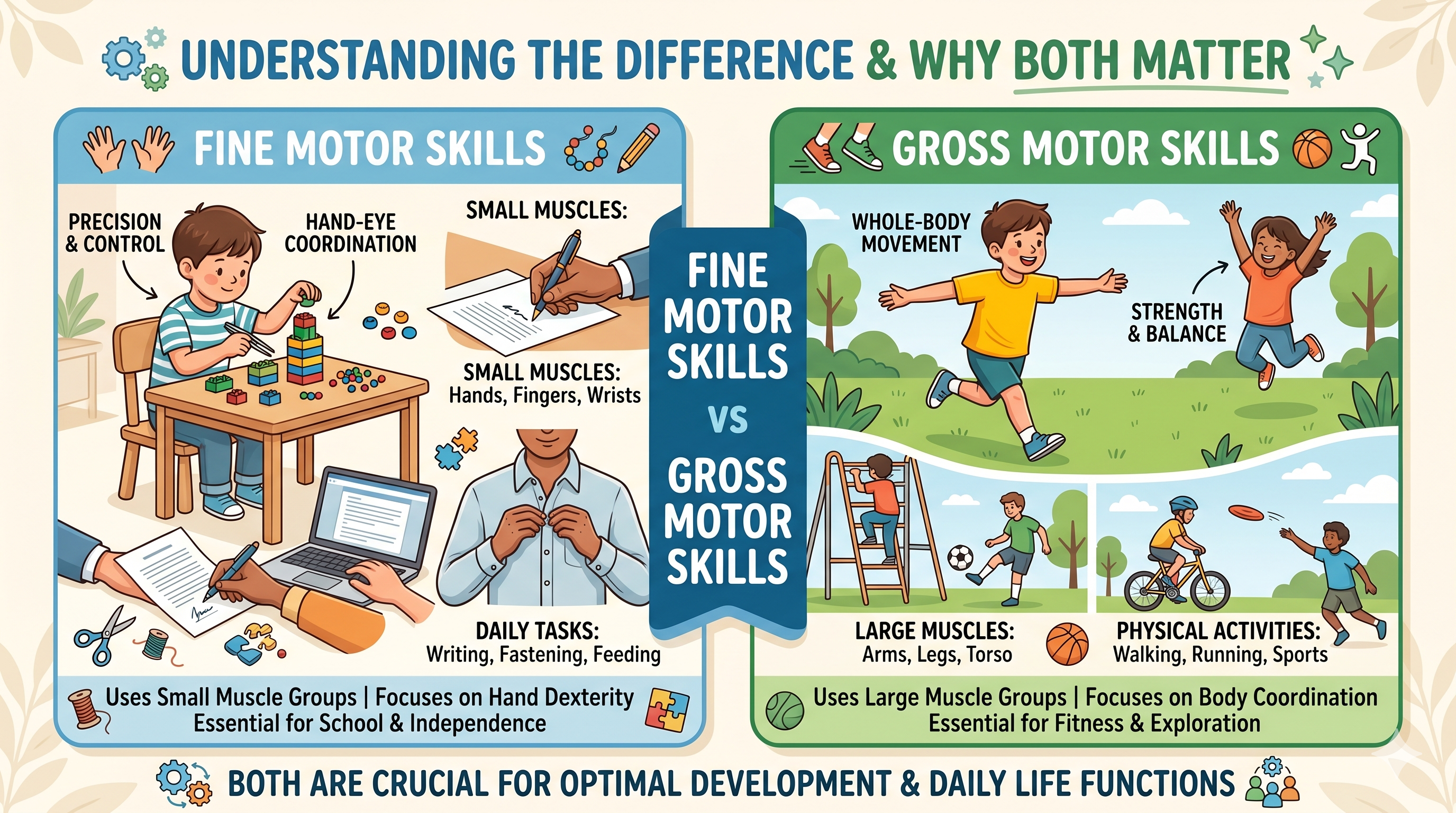
Fine motor skills involve the coordinated use of the small muscles in the hands, fingers, and wrists to perform precise, controlled movements. These skills underpin tasks such as writing, drawing, cutting with scissors, fastening buttons, using cutlery, and manipulating small objects.
Examples: Holding a pencil, tying shoelaces, threading beads, turning pages, using a spoon.
Gross motor skills involve the large muscle groups of the arms, legs, and core to produce whole-body movements. These are the skills that enable children to sit upright, walk, run, jump, climb, throw, and maintain balance — abilities essential for physical independence, play, and social participation.
Examples: Running, jumping, hopping, swimming, kicking a ball, climbing stairs, riding a bicycle.
Fine and gross motor skills are not isolated abilities — they develop together and support each other in important ways. A child who lacks core strength (a gross motor skill) will struggle to sit upright at a desk, which in turn affects their ability to write (a fine motor skill). Both skill sets are essential for school readiness, peer interaction, and everyday independence.
A 2025 systematic review and meta-analysis published in Frontiers in Sports found a significant positive relationship between fine motor skills and academic achievement in children aged 3–10. The research confirmed that children who spend 31–60% of their school day on fine motor tasks — writing, drawing, cutting — benefit considerably when these skills are well developed.
Source: Li et al. (2025). Research progress on the relationship between fine motor skills and academic ability in children: a systematic review and meta-analysis. Frontiers in Sports.
Children develop motor skills in a broadly predictable sequence, though every child's pace is unique. The following gives a general guide to what to expect:
Age 1–2 years Gross: Walking independently, climbing stairs with support, throwing a ball. Fine: Pincer grasp (thumb and forefinger), turning pages, stacking 2–3 blocks.
Age 3–4 years Gross: Running, jumping, hopping on one foot, pedalling a tricycle. Fine: Holding a crayon, cutting with scissors, drawing simple shapes.
Age 5–6 years Gross: Skipping, catching a bounced ball, balancing on one foot for 5+ seconds. Fine: Writing letters, using a fork and knife, tying shoelaces.
Age 7–8 years Gross: Riding a bicycle, coordinated sports movements, swimming. Fine: Fluid handwriting, detailed drawings, independently managing clothing fasteners.
Consistent difficulty with age-appropriate motor tasks — beyond normal variation — may signal a developmental delay that warrants professional assessment. Watch for these indicators:
Occupational therapists are uniquely positioned to assess and treat both fine and gross motor delays in children. Using a holistic, play-based approach, OTs design personalised intervention programmes that target the specific skills a child finds challenging — in a way that is engaging, motivating, and developmentally appropriate.
An OT will conduct a thorough assessment using standardised tools such as the Movement Assessment Battery for Children (MABC-2) or the Bruininks-Oseretsky Test of Motor Proficiency (BOT-2) to identify areas of difficulty and set measurable, meaningful goals.
Therapists use activities like bead threading, clay modelling, cutting and pasting, handwriting programmes, and in-hand manipulation exercises to build finger strength, dexterity, and hand-eye coordination. A 2025 study in Occupational Therapy International confirmed that underdeveloped fine motor skills are a key contributor to handwriting difficulty in school-age children, emphasising the need for targeted OT intervention.
For gross motor delays, OTs use obstacle courses, balance boards, ball activities, climbing, and coordination games. A 2024 meta-analysis in Frontiers in Public Health found that motor development-focused exercise training is significantly more effective at improving gross motor skills in preschool children than ordinary physical activity alone.
Effective OT extends beyond the clinic. Therapists provide parents and teachers with tailored home programmes, classroom strategies, and environmental modifications to reinforce progress and build skills in real-life contexts.
Whether your child is struggling with handwriting, finds physical play difficult, or simply seems a little behind peers in everyday tasks — an occupational therapy assessment can provide clarity and a clear path forward. At Madhumita The Occupational Therapy Centre, our therapists use evidence-based, play-centred approaches to assess both fine and gross motor skills and design personalised programmes that make a real, lasting difference.
You do not need a referral or a formal diagnosis to reach out. We welcome families at any stage and are happy to answer your questions before any commitment is made.
Book a Motor Skills Assessment → Contact Madhumita The Occupational Therapy Centre, Shyamal, Ahmedabad
© 2026 Madhumita The Occupational Therapy Centre | Shyamal, Ahmedabad, Gujarat, India


